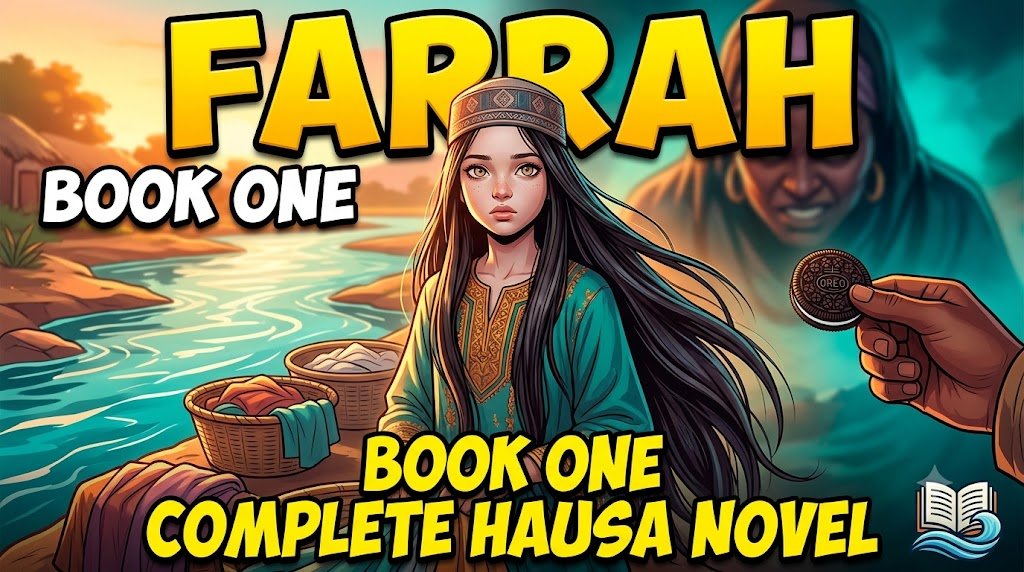
Farrah Book One Complete Hausa Novel: Narrative Overview
Farrah Book One Complete Hausa Novel, written by M Shakur. The story contrasts two vastly different lives: Farrah, a young speech-impaired orphan enduring severe mistreatment in a rural village, and Zayn, an extremely wealthy, reckless heir returning to Nigeria from abroad.
Below is the complete narrative adaptation and summary for Chapters 1 and 2.
Chapter 1: Cruelty and Domestic Hardship
Tensions at Home
Following the afternoon prayer (Asr), Malam arrived home to find Farrah lying unconscious on the kitchen floor. Exhausted and thin, he walked past her into the main room. Inna, sitting in the courtyard, glared at him in frustration. Malam grabbed a small radio from atop their old television set, pulled out the antenna, and tuned it to the BBC Hausa service.
“What a tragic, lifeless excuse for a man you are,” Inna muttered angrily.
Ignoring her insults, Malam took a rolled-up mat standing nearby. Inna snapped, “I bought that mat with my own money, you shameless man!” Malam spread the mat outside, set down his radio, and walked over to Farrah. He picked up his plastic kettle (buta) from earlier and shook it to check for remaining water. Looking down at Farrah, he was reminded of his deceased younger sister who died at her age.
He poured water over Farrah’s face, calling out, “Hey, Farrah! Get up!”
Farrah stirred, wincing from the water, before jumping up in terror. Her sudden movement knocked over several cooking pots as she let out silent, distressed sounds.
Malam scolded her, “Are you trying to ruin this house with eyes like a water demon? Where did you learn to steal? If you keep stealing, the people in this village will kill you! Look at yourself—skinny, wearing rags, living off scraps, yet you steal from those feeding you. Don’t you care about your own life?”
Farrah bowed her head, silently crying as she wiped her tears with the back of her hand.
Malam ordered, “Move, serve my food, and cover the pot you left open on the ground.”
Before Farrah could move, Inna stormed over from the kitchen. “He will not touch that food, Malam!” she declared. “Your five naira didn’t contribute to this meal. As for you, you useless girl, touch that pot and see if I don’t chop off those pale hands!”
Scared of Inna, Farrah crouched down with her eyes squeezed shut, trembling.
Malam, smelling the jollof rice, tried to calm Inna down. “Basira, my wife, did the village head’s wives fail to pay you for your chores today? Why are you so upset?”
“Mind your own business, hypocrite,” she snapped, turning away.
Malam caught her hand gently. “Please, Basira, serve me some rice. I am starving.”
Inna snatched her arm back. “You insult me because of a mute, useless orphan! Let her cook for you instead!”
“Come on, Basira, I apologized,” Malam pleaded. “I’m going to see Luku later to get some money. Besides, look at how eligible suitors are queuing up for our daughter, Rakiya. I agree with your plan for her to marry the Village Head’s son.”
Inna smiled, flattered. “Rakiya’s skin is fair, but I bought a special lotion at the market to make her even lighter. That mute girl over there stays out in the sun all day, getting dark and ugly. She can’t outshine my daughter.” She glared at Farrah before finally serving Malam his plate.
“Now go fill every water clay pot in this compound,” Inna commanded Farrah. “If you don’t, you’ll regret it.”
Farrah quietly put on mismatched slippers, placed a large clay pot on her head, and headed out toward the distant river before sunset.
Encounter at the Stream
As Farrah walked down the path, a voice called out, “Hey, Mute!”
She paused, recognizing the voice, and attempted to pronounce her friend’s name: “Taaaa… fff… fa!”
A young Fulani girl jumped down from a mango tree along the path. She was dressed in traditional Fulani attire with a black headscarf. Smiling, she handed Farrah a mango.
“Must you struggle to say my name?” Shafa teased playfully. “My name is Shafa, not Tafa! You stubborn girl.”
Shafa took the heavy pot off Farrah’s head and carried it for her. “I feel sorry for you. Let’s go fetch the water together. Did Modibbo bother you again today?”
Farrah shook her head.
“Good,” Shafa said. “If he corners you again, don’t show fear. Remind him that Rakiya is in love with him and to stay away.”
Shafa was Farrah’s only true friend in the village—protective, outspoken, and quick to defend her against bullies like Rakiya.
When they reached the riverbank, they saw Modibbo—the wealthy, handsome, and arrogant only son of the Village Head—sitting with six friends around a fire, brewing tea. Seeing them, Farrah stopped in her tracks.
Modibbo stood up, dressed in clean, expensive clothes. He walked over and called out softly, “Farrah.”
Shafa quickly pushed Farrah toward the water. “Hold the pot, Kurma,” she said, before turning to face Modibbo. “Hamma Modibbo, leave Farrah alone. You set up your gathering here just because you knew she fetches water at this time. Everyone knows Rakiya loves you. Who would let you marry a mute orphan anyway? Have mercy on her.”
Modibbo laughed mockingly, supported by his friends. He walked past Shafa, grabbed the pot Farrah was struggling with, and offered, “Let me help you lift it.”
Terrified, Farrah stepped back, but Modibbo placed the pot on her head. Before she could hurry away, he pulled an imported Oreo biscuit pack from his pocket—a luxury unseen in the village.
“Take it,” he insisted. “It’s imported biscuits. If you refuse, I’ll make sure Shafa’s family is banished from this village.”
To protect her friend, Farrah hesitantly accepted the gift. She quickly left with Shafa.
Behind them, Modibbo’s friends teased him about chasing a poor, speech-impaired orphan. Modibbo smirked and drank his tea, boasting callously about his sinister intentions to exploit Farrah the following evening.
Chapter 2: The Wealthy and Reckless Heir
The Search for Zayn
In Indianapolis, USA, an elderly man in a dark blue suit paced back and forth in a luxury mansion. Bodyguards in black suits and dark glasses stood post. A bodyguard’s phone rang; it was a call from the young man’s father, Tajudeen Ganuwa—the second richest man in the world.
Taking the phone, the man (Zayn’s uncle, Hali) reported, “We checked all his usual spots, Yaya. He wasn’t there. We are back at his house now; he has to come home eventually. Don’t worry, I promise I will bring Zayn back to Nigeria.”
Moments later, the automated gate opened, and a luxury Ferrari 296 GTB pulled into the driveway. A tall, handsome, dark-skinned young man stepped out wearing high-end designer clothing, designer sandals, and a hoodie. He had broad shoulders, neat facial hair with dyed accents, and an indifferent demeanor.
Chewing gum casually, 26-year-old Zayn entered his home using a keypad lock. Seeing Uncle Hali and six bodyguards waiting inside, his expression hardened.
He walked to the mirror-finish refrigerator, grabbed a bottle of water, spat his gum on the floor, and asked in a lazy tone, “What do you want, Uncle?”
“Your father ordered me to bring you back to Nigeria,” Uncle Hali stated firmly.
Zayn’s face darkened. “I am not going anywhere,” he retorted, turning toward the door. “Take these men and leave my house.”
The bodyguards blocked the exit on Uncle Hali’s order. In a fit of rage, Zayn kicked an expensive decorative vase, shattering it across the floor. He sank into a couch, pulled out a luxury cigarette, lit it, and dialed his father.
“What is the meaning of this, Papa?” Zayn shouted into the phone. “Am I a child that you send people from Nigeria to retrieve me in Indianapolis?”
After a tense 20-minute argument, his father prevailed. Frustrated, Zayn threw his custom gold iPhone onto the floor, cracking its screen. Uncle Hali picked up the device, confirmed the travel arrangements with Tajudeen, packed Zayn’s essentials, and escorted him to the private airport.
The Journey to Abuja
They boarded a private jet owned by Ganuwa Airlines. Throughout the flight prep, Zayn remained irritable, demanding his headphones and complaining bitterly.
During the flight, Zayn engaged in a quick, careless encounter with a flight attendant before sleeping through the remainder of the journey.
The private jet eventually landed at the international airport in Abuja, Nigeria, where staff awaited the arrival of Tajudeen Ganuwa’s only son.
Story Comparison & Character Overview
| Character | Location | Social Status / Description |
| Farrah | Rural Village | Orphaned, speech-impaired girl facing abuse at home and exploitation by local youths. |
| Zayn Ganuwa | Indianapolis / Abuja | 26-year-old wealthy heir to the Ganuwa fortune; rebellious and spoiled. |
| Inna | Rural Village | Farrah’s stepmother; harsh, abusive, and focused on her own daughter’s prospects. |
| Malam | Rural Village | Farrah’s father/guardian; poor, easily manipulated by Inna. |
| Shafa | Rural Village | Farrah’s loyal, protective, and outspoken best friend. |
| Modibbo | Rural Village | Son of the Village Head; predatory and arrogant. |
| Uncle Hali | USA / Nigeria | Zayn’s patient uncle tasked with bringing him back home. |
Key Plot Highlights
-
Farrah’s Vulnerability: Deprived of care and mute, Farrah relies entirely on her friend Shafa while being targeted by Modibbo.
-
Zayn’s Privilege: Living in extreme luxury abroad, Zayn displays deep resentment toward his father’s strict authority.
-
Converging Paths: The narrative establishes a sharp contrast between extreme rural poverty and extreme urban wealth, setting up the broader arc of the novel.